
“In the beginning was the Word, and the Word was with God, and the Word was God.”
— John 1:1 (KJV)
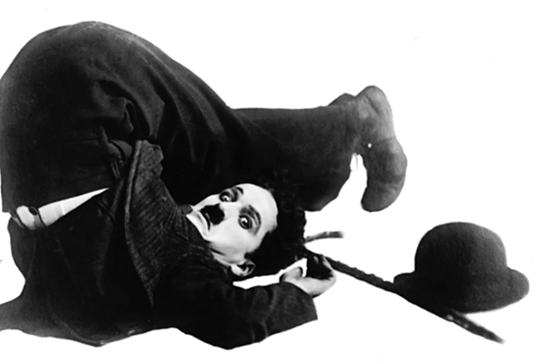
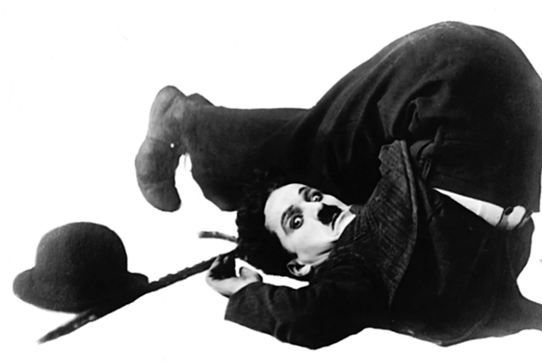
Charles Chaplin is a name that commands respect, as he is widely regarded as one of the founders and leading figures of modern cinema. Interestingly, he was long reluctant to make sound films. He believed that his ‘Tramp’ character, which was based on universal, silent physical comedy, had no place in a sound film. In 1940, *The Great Dictator*, his first sound film, was released. The impact it had was immense. Not only had the Tramp spoken, but look at what he had said! This film is very useful for studying two types of political representation in which the spoken word, noise, demagoguery and images are combined to move the audience. This is also the last film in which the Tramp appeared.
“The Great Dictator” is a political satire film in which Chaplin plays two characters, one is a poor Jewish barber, the other a ruthless fascist dictator. Each with a very particular way of perfomance. Adenoid Hynkel, the ruthless fascist dictator of Tomainia, turns political authority into a theatrical spectacle through exaggerated speech, gesture, and movement. The poor Jewish barber, by contrast, eventually delivers a speech calling for freedom, solidarity, and human fraternity. The contrast might seem straightforward: Hynkel manipulates his audience, while the barber offers a moral alternative. Yet both characters rely on performance to reach and influence others. Their voices, bodies, and relationships to the camera shape not only what their political ideas mean but how those ideas are felt.
This tension raises the essay’s central question: what distinguishes an ethical use of cinematic performance from a manipulative one? Hynkel’s speeches are often unintelligible, but they are not without effect. Rhythm, volume, gesture, the crowd’s reactions, and the technologies amplifying his voice all contribute to his authority. The barber’s final speech, meanwhile, communicates a recognizable moral position, but its persuasive force also depends on vocal intensity, framing, music, editing, and direct address. The film therefore does not simply oppose empty spectacle to meaningful speech. It asks how cinematic form can shape different relationships between authority and spectatorship.
James Naremore’s account of film acting offers a complementary starting point. A screen gesture does not carry a single, self-evident meaning: its significance is shaped by the actor’s physical work, the narrative context, and the way the film presents that work to spectators. This is especially useful for a film in which Chaplin’s body can make political authority comic, threatening, or vulnerable depending on the scene’s framing and context (Naremore 19–32).
Adrian Daub’s “‘Hannah, Can You Hear Me?’—Chaplin’s Great Dictator, “Schtonk”, and the Vicissitudes of Voice, offers a framework for examining this problem. Daub considers how sound cinema makes voice bodily through tone, cadence, and accent, complicating any simple opposition between language and physical expression. In The Great Dictator, Hynkel’s vocal performance exerts force even when the audience cannot understand his words. The barber’s final speech, by contrast, seeks to communicate a shared moral vision. Yet Daub also questions whether that appeal can escape the emotional and rhetorical conventions through which it reaches its audience.
I argue that The Great Dictator uses performance and cinematic form to contrast two visions of political power. Hynkel’s body and voice turn domination into a spectacle of possession, while the barber attempts to redirect cinema’s persuasive capacities toward solidarity and resistance. The distinction is not between persuasion and its absence: both performances seek to move an audience. The question is whether a performance demands submission to an authority or invites spectators to imagine themselves as participants in a shared world.
Hynkel’s Opening Speech: The Performance and Circulation of Political Power
Before Hynkel begins speaking, the film shows a printing press producing newspapers. This introduces the infrastructure through which the regime circulates its official image and language, suggesting that Hynkel’s authority extends beyond his physical presence.
This introduction becomes significant once Hynkel begins addressing his audience. His speech is delivered in a mixture of pseudo-German sounds, exaggerated vocal rhythms, and occasional recognizable words. Although much of what he says is unintelligible, the performance is not meaningless. Words that sound like references to Europe, emerge from the stream of gibberish, while the force of his delivery communicates aggression and intimidation. The speech is comic because of its excess, but it can also be disturbing. The exaggerated vocal performance suggests a speaker whose desire to dominate exceeds the need to communicate a coherent argument. The microphones bending under Hynkel’s voice make its force visible. The gag is comic, but it also gives sound a physical effect: his voice seems to act upon the world before its meaning can be understood. It becomes a display of power in itself.
Daub’s discussion of Hynkel’s peculiar language helps clarify this distinction between semantic meaning and vocal force. Hynkel’s speeches produce a kind of public language that does not require ordinary communication between speaker and listener. His invented vocabulary establishes the impression of a private language made public, one that separates the dictator from those who must interpret and respond to him (Daub 453–56). Yet the speech is not completely detached from meaning. Even when its words cannot be understood, its rhythm, volume, and physical intensity suggest hostility. The audience encounters a performance that communicates through affect as much as through language.
The interpreter and radio announcer further complicate the scene. The interpreter translates Hynkel’s speech into an official account of what the dictator supposedly means. At one point, following a burst of gibberish, the interpreter announces that Hynkel has referred to the Jewish people. The gap between the sound of the speech and its translation creates uncertainty about the relationship between what is spoken and what is represented as having been said. The audience is asked to consider not only Hynkel’s performance but also the mechanisms that authorize an interpretation of it.
Hynkel also controls the rhythm of the crowd’s response through gestures. He waves to encourage his supporters to shout, then waves again to silence them. The crowd’s reactions become part of his performance: their enthusiasm confirms the authority he displays, while his gestures demonstrate his ability to regulate that enthusiasm. The audience within the film is not simply listening. It is participating in a spectacle whose rhythm is controlled by the person at its center.
The radio announcer continues to narrate even when Hynkel leaves the frame and falls down the stairs. Rather than report the fall, the announcer maintains the official account that Hynkel is about to descend the stairs. The discrepancy between the visible body and the spoken description is comic, but it also reveals the persistence of official representation. The narration continues to protect the image of authority even when the dictator’s body temporarily undermines it.
The opening speech presents political authority as something produced and sustained through performance and mediation. Hynkel’s voice overwhelms the space, his gestures regulate the crowd, and the communications apparatus protects the official account of his actions. The scene’s central contradiction is that a performance can look absurd while still organizing fear, attention, and collective response.
The Globe Dance: Choreographing the Fantasy of Domination
The globe dance develops the relationship between performance and political authority through movement. Where the opening speech makes Hynkel’s voice seem capable of overwhelming a space, the dance turns domination into a bodily fantasy of possession. The world becomes a toy in a private performance, and the sequence gradually reveals the fragility of the control Hynkel imagines he possesses.
The sequence begins after Garbitsch flatters Hynkel, appealing to his vanity and encouraging his sense of importance. Hynkel responds physically before the dance fully begins: he rushes toward the curtains and climbs them, wrapping his legs around the fabric. The movement is comic, theatrical, and suggestively sexual. His excitement seems to exceed the boundaries of political conduct, making his body a spectacle of narcissism and revealing a relationship to power based on pleasure as well as authority. The relatively sustained framing also lets the spectator appreciate Chaplin’s physical precision: the comedy depends on seeing the performer’s body and the globe’s trajectory together, rather than on isolated close-ups. The shot presents the dance as a sustained bodily accomplishment while keeping the object’s movement available for comparison with Hynkel’s gestures (Naremore 19–32).
When Hynkel begins dancing with the globe, he treats it like a delicate partner. He tosses it into the air, catches it on his fingertips, and kicks it toward a bust that appears to represent Caesar. The globe’s movement becomes part of an elaborate choreography that alternates between apparent grace and aggressive control. The camera’s relatively stable framing allows the spectator to follow the movement across the office, making Hynkel’s body and the object the focus of the spectacle. The sustained framing also lets viewers appreciate the coordination of Chaplin’s body and the globe’s trajectory: the comedy depends on seeing the performer’s movement in relation to the object, rather than on isolated close-ups. This illustrates Naremore’s broader point that a screen performance is shaped by how the film presents an actor’s physical work to spectators (19–32).
The setting places this private fantasy within the regime’s larger political project. As Hynkel moves across his desk and sends the globe upward, the Double Cross symbol remains visible behind him. The globe is not merely a prop: it represents the world over which he wishes to exercise power. By reducing it to an object that can be handled and manipulated, Hynkel imagines global domination as a personal possession.
The movement of the globe also exposes the limits of Hynkel’s control. It bounces and moves according to its own physical properties, disrupting the smoothness of his choreography. At one point it rebounds against Hynkel’s head, and he appears to fly backward onto the desk. The effect may involve a cinematic trick, but its exact technique is less important than the result: the film makes his body seem to exceed ordinary physical limits, while the unpredictable object interrupts his fantasy of mastery. The moment matters because cinema seems to grant Hynkel’s body powers beyond ordinary movement, even as the globe’s unpredictability undermines his fantasy of control.
The dance also invites a sexual interpretation. Hynkel bounces the globe with his buttocks and draws it close to his groin, making his desire for political possession appear bodily and intimate. Daub similarly reads the sequence through the sexualized theatricality of Hynkel’s movements, noting the lewd quality of his interaction with the globe (472–73). This reading is grounded in the choreography, though it remains an interpretation rather than the scene’s only possible meaning.
The fantasy collapses when the globe explodes. Hynkel’s expression shifts from excitement to devastation, and the music changes with the mood of the scene. The object that seemed to extend his power becomes something he cannot preserve. The rupture does not undo the political violence represented by Hynkel, but it punctures the image of effortless control that his performance has constructed.
The music also connects the dance to the film’s ending, where the same passage returns as Hannah responds to the barber’s speech. The musical cue does not carry a fixed political meaning: in the dance it accompanies Hynkel’s fantasy of possession, while in the ending it supports the possibility of hope. Its meaning changes through its relationship to bodies, images, and narrative context.
The globe dance anticipates the film’s final ethical problem. Hynkel constructs a world in which he imagines himself as master, but the film exposes the fragility of that construction. The barber offers a different vision of collective life, though his appeal also depends on performance and cinematic form. The difference is not that one vision is constructed and the other natural; both are constructed. What differs is the relationship each proposes between people and the world they share.
The Barber’s Speech: From Emotional Intensity to Ethical Persuasion
The barber’s final speech appears to provide a direct answer to Hynkel’s political spectacle. Instead of delivering an unintelligible performance of authority, the barber speaks in recognizable language about freedom, cooperation, and the need to resist oppression. His words offer an explicit alternative to the regime’s ideology. Nevertheless, the scene’s significance lies not only in what he says but also in how his performance and the camera transform his speech into an appeal to spectators.
The barber begins by declaring that he does not want to be an emperor. He then explains that he wants to help people, establishing a vision of human relations based on mutual care rather than domination. His statement that human beings want to live through one another’s happiness rather than one another’s misery presents fraternity as an alternative to political competition. The speech develops a moral argument in which the value of collective life depends on recognizing the humanity of others.
The linguistic contrast is clear: Hynkel’s invented vocabulary frustrates comprehension, while the barber’s propositions can be followed and evaluated. But the contrast is not simply between meaningless and meaningful speech. Hynkel’s voice, gestures, and control of the crowd produce an affective response even when his language remains unintelligible.
The barber also draws on emotional expression. His speech begins in a relatively restrained manner and gradually intensifies. As the speech progresses, his voice grows louder, his gestures become more pronounced, and his body begins to play a more visible role in the argument. The shift from restraint to intensity gives the speech a dramatic structure. Rather than presenting a moral stance in a uniform tone, the barber’s delivery guides the audience through a progression of emotions.
This progression becomes especially evident when he addresses the soldiers directly: “Soldiers, do not surrender to the brutes.” The change in the way he addresses them alters the relationship between the speaker and the audience. He is no longer speaking solely about a general vision of humanity. He is confronting individuals whose actions can either perpetuate oppression or contribute to the resistance. His voice becomes more forceful because the speech now makes a demand of his listeners. The barber does not abandon emotional appeal in order to convey moral seriousness. On the contrary, emotion becomes one of the means through which his moral stance gains strength. He continues to address the soldiers and declares that they must fight for freedom rather than for slavery. His speech shifts from describing the problem to proposing an alternative.
The camera contributes to this progression. Hynkel’s opening speech allows him to move broadly through the space, advancing and retreating while the camera accommodates his physical spectacle. The barber’s final address, by contrast, maintains a closer relationship between the speaker and the camera. His body occupies a more restricted field of movement, and the image emphasizes his face, voice, and gestures rather than presenting him as a figure moving freely through an expansive political space.
This difference in framing changes the spectator’s relationship to each performer. Hynkel’s movement invites the audience to watch a spectacle of authority; the barber’s closer presentation draws attention to the emotional changes visible in his face and body. The camera does not eliminate performance but reorganizes it.
The effect becomes particularly pronounced when the camera tracks closer as the barber invokes the idea that the Kingdom of God is within human beings. The movement toward a tighter image intensifies the sense of address. The speech moves from an appeal to a broad political audience toward a more direct confrontation with the spectator. The barber’s gaze seems to extend beyond the people he addresses within the film and toward those watching it.
This direct gaze is important because it can feel both involving and slightly intimidating. The spectator is not allowed to remain entirely detached from the moral demand being made. The speech asks viewers to consider their own relationship to the ideals it expresses. Cinema’s capacity to construct a direct encounter with a performer becomes part of the speech’s ethical force.
At this moment, it can feel as though Chaplin the artist is speaking through the barber. The character’s identity as the Jewish barber becomes less important than his role as the vehicle for a public appeal. Yet the speech does not cease to be a performance simply because it seems to express the filmmaker’s own convictions. Its moral seriousness is communicated through the same cinematic mechanisms that have shaped Hynkel’s spectacle: vocal delivery, gesture, framing, and the organization of attention.
Daub helps clarify the difficulty of distinguishing the two performances. The barber’s speech seeks to replace Hynkel’s exclusionary politics with a language of fraternity, yet its emotional force depends on public rhetoric and on the audience’s willingness to respond to its sentimentality (Daub 473–75). The speech does not escape persuasion; it attempts to use persuasion for a different end.
This tension does not make the barber’s appeal ethically equivalent to Hynkel’s. Both use voice and body to seek a response, but Hynkel demands submission to his authority, while the barber calls on listeners to resist oppression and recognize other people’s humanity. Their formal similarities matter, but they do not erase the difference between the relationships they ask an audience to accept.
The distinction, then, is not between emotional performance and pure reason. The barber’s speech is persuasive partly because it is emotional. Its ethical claim depends on the possibility that people can be moved to reject oppression and imagine different forms of social life. Cinema’s capacity to guide feeling need not amount only to manipulation, though the film leaves open how far an emotionally powerful appeal can produce political change.
The film’s historical reception also cautions against treating this moral appeal as universally persuasive. Willie Hiatt’s account of the film’s 1941 circulation in Latin America documents sharply divided responses: some defended it as a defense of democracy, while others supported censorship or condemned the final speech as an artistic failure. The film’s political meaning was therefore not secured by Chaplin’s intention or by its formal choices alone; it emerged amid local disputes over censorship, sovereignty, and democratic legitimacy (Hiatt 777–80, 796–97). This history does not invalidate the film’s ethical vision, but it reminds us that the invitation to solidarity could be interpreted, rejected, or appropriated differently by audiences in different contexts.
The barber’s speech therefore offers an ethical alternative without escaping the problem of persuasion. Its performance is constructed, its emotions are organized, and its direct address guides spectators toward a response. Those features do not automatically invalidate its moral claims. Instead, they sharpen the film’s central question: can cinema move an audience while inviting its members to think of themselves as free participants in a shared world, rather than followers submitting to an authority?
Hannah’s Response: From Public Address to Private Hope
The film’s ending shifts attention from the barber’s public address to Hannah’s response. The editing moves between the barber and the cheering crowd before turning to Hannah, who lies on the ground. The return of the music associated with Hynkel’s globe dance connects the two sequences, but the images give the musical passage a different significance.
During the globe dance, the music accompanies Hynkel’s fantasy of possessing the world; when the globe bursts, his imagined mastery collapses. In the final sequence, the same music accompanies Hannah’s gradual response to the barber’s words. Rather than underscoring possession, it now gives emotional shape to the possibility of hope. The shift shows how music’s meaning depends on the images and performances with which it is paired.
Hannah’s reaction develops through a series of images. She initially lifts her head with uncertainty, as though she is not yet prepared to accept what she has heard. As the speech continues, her expression changes. She gradually becomes more receptive tits message, eventually rising and looking upward. The editing gives this transformation time to unfold, allowing the spectator to observe not only a response to language but also a change in bodily orientation.
The relationship between the speech and Hannah’s reaction Is especially Important because she is not simply another member of the cheering crowd. The sequence brings the public address into contact with an individual whose response appears hesitant and personal. The film moves from the scale of mass communication toward a quieter image of a person considering the possibility of a different future.
The words establish the barber’s moral appeal, but music, editing, and reaction shots shape how that appeal is felt. Hannah’s response becomes a model for the spectator’s possible response, so hope is not only expressed through dialogue; it is produced as a cinematic experience.
Hannah’s upward gaze suggests a movement away from the immediate conditions of fear and toward something that cannot yet be seen. Her gesture does not establish that the world described by the barber will come into existence. Instead, it makes that world imaginable. The distinction matters because the film’s emotional conclusion could otherwise be mistaken for a guarantee of political transformation.
The image of Hannah’s hand near her belly might invite an association with motherhood, fertility, or continuity. Such an interpretation, however, remains tentative. The gesture alone cannot establish that she is pregnant or that the film intends a specific symbolic meaning. What can be observed more securely is that her bodily response contributes to the sequence’s emphasis on the possibility of life beyond the immediate violence of the story.
Hynkel imagines a world organized around his own possession and authority, while Hannah’s response suggests the possibility of a world organized around solidarity and freedom. The repeated music links these visions without making them equivalent. In both sequences, music makes a vision emotionally available; what differs is the kind of relationship to the world that each vision asks us to value.
At the same time, the ending remains unresolved. Hannah’s response can signify hope, but it cannot demonstrate that the political conditions surrounding her have changed. The barber’s speech may inspire resistance, yet the film does not show the complete realization of the world he describes. The final sequence therefore preserves a tension between emotional certainty and political uncertainty.
Conclusion: The Ethics of Cinematic Persuasion
Ultimately, The Great Dictator presents cinema’s ethical potential not as an escape from performance but as a question about how performance is used. Voice, gesture, music, framing, and editing can organize spectatorship around domination, but they can also make solidarity imaginable. These formal choices are not automatically ethical or unethical; their significance emerges from the relationships they construct between performers, audiences, and the world represented. The film offers a vision of freedom without guaranteeing its realization. What is guaranteed, however, is that a feeling will be evoked through the power of sound, and that this will have an effect. A powerful one.
So, what works best? Is it necessary to develop a logical argument to win support in the political arena, or is it better to not make much sense but rely on theatricality? This seems like an interesting point to keep in mind as we look ahead to upcoming political meetings.
Bibliograpfhy
Naremore, James. Acting in the cinema. University of California Press, 1988.
Hiatt, Willie. Slapstick Diplomacy: Charlie Chaplin´s The great Dictator and Latin American Theatres of War. Cambridge University Press, 2018.
Daub Adrian. “Hanna, can You Hear me?” – Chaplin´s Great Dictator, “Schtonk”, and the vicissitudes of Voice. Wayne State University Press, 2009.